Florence in Spring: Is March, April or May Best?
Compare Florence in March, April and May by temperature, rainfall and daylight, with clear advice on the best spring month for your trip.
The short answer
April is the best all-round choice for Florence in spring. Its typical daytime high is 19.2°C, evenings are milder than in March, and there are about 13 hours 25 minutes of daylight by the middle of the month. It has the same median number of rain days as March and fewer than May.
Choose March if you prefer cooler walking conditions and do not mind cold evenings. Choose May if warm weather and long evenings matter more than minimising rain risk.
These figures describe typical conditions rather than a forecast for a particular trip. Florence can vary considerably within each month, so check a current forecast before packing.
March vs April vs May at a glance
| Month | Median daytime high | Median night low | Median rain days | Median monthly rain | Daylight around the 15th | Best for |
|---|---|---|---|---|---|---|
| March | 15.6°C | 5.4°C | 10.5 | 72.5 mm | 11 hr 52 min | Cool-weather walking and travellers comfortable with layers |
| April | 19.2°C | 8.1°C | 10.5 | 80.7 mm | 13 hr 25 min | The best balance of mild temperatures, rain risk and daylight |
| May | 22.6°C | 11.9°C | 13.5 | 101.6 mm | 14 hr 43 min | Warm outdoor time and long evenings |
The main trade-off is straightforward: Florence becomes progressively warmer and lighter from March to May, but May is also the wettest of the three months in this climate record.
March: best for cooler city walking
March has a median daytime high of 15.6°C and a median night low of 5.4°C. The recorded spread is broad: daytime highs range from 11°C at the cooler end of the dataset to 19.3°C at the warmer end. A March visit therefore needs flexible layers rather than one fixed seasonal wardrobe.
Rain falls on a median 10.5 days, with 72.5 mm across the month. That is the lowest monthly total of the three spring options, although it does not make March reliably dry.
Around 15 March, Florence has 11 hours 52 minutes of daylight, with sunrise at 06:27 and sunset at 18:20 in the 2026 daylight profile. Day length increases substantially during the month, from 11 hours 10 minutes on the first day to 12 hours 41 minutes on the last.
Pick March if:
- you find 15–16°C comfortable for walking;
- you are planning a museum-focused visit with outdoor sightseeing between indoor stops;
- you do not mind needing a warmer layer after sunset;
- you value lower typical rainfall totals more than long evenings.
Think twice if: you want consistently mild evenings or expect to spend most of each day outdoors. March has the coldest nights and shortest days of the three choices.
For more detail, see Florence in March.
April: the best overall balance
April raises the median daytime high to 19.2°C and the median night low to 8.1°C. Its typical daytime range is also wide, from 14.6°C at the cooler end to 23.3°C at the warmer end, so both light and warmer layers remain useful.
The median number of rain days is 10.5, the same as March, while median monthly rainfall rises slightly to 80.7 mm. April therefore offers a meaningful improvement in warmth and daylight without the higher rain frequency recorded in May.
Around 15 April, Florence has 13 hours 25 minutes of daylight. The 2026 profile places sunrise at 06:32 and sunset at 19:57. That extra daylight makes it easier to separate a major museum visit from an afternoon or evening walk rather than compressing both into a shorter day.
Pick April if:
- this is your first trip and you want the most balanced spring conditions;
- you plan to combine museums, streets and viewpoints in the same itinerary;
- you want milder weather than March without prioritising the warmest possible month;
- you prefer fewer typical rain days than May.
April is not a dry-season guarantee. Keep an indoor alternative available and check museum admission arrangements before travelling.
For month-specific planning, read Florence in April.
May: best for warmth and long evenings
May is the warmest spring option. The median daytime high is 22.6°C and the median night low is 11.9°C. Daytime highs in the dataset range from 18.3°C at the cooler end to 26.7°C at the warmer end, making extended outdoor sightseeing more comfortable for travellers who dislike cool conditions.
It also offers the most daylight. Around 15 May, the day lasts 14 hours 43 minutes, with sunrise at 05:49 and sunset at 20:32 in the 2026 profile. This provides almost three more hours of daylight than mid-March.
The compromise is rain. May records a median 13.5 rain days and 101.6 mm of precipitation, both the highest of the three spring months. Do not choose May on the assumption that later spring necessarily means drier weather in Florence.
Pick May if:
- warm daytime conditions are your priority;
- you want long evenings for walking through the centre;
- you are comfortable planning around a higher statistical chance of rain;
- cold evenings would reduce your enjoyment of the trip.
Think twice if: your itinerary depends heavily on dry outdoor time. May provides warmer conditions but not the lowest rain risk.
See Florence in May for a dedicated guide.
What stays the same throughout spring
Florence remains practical on foot
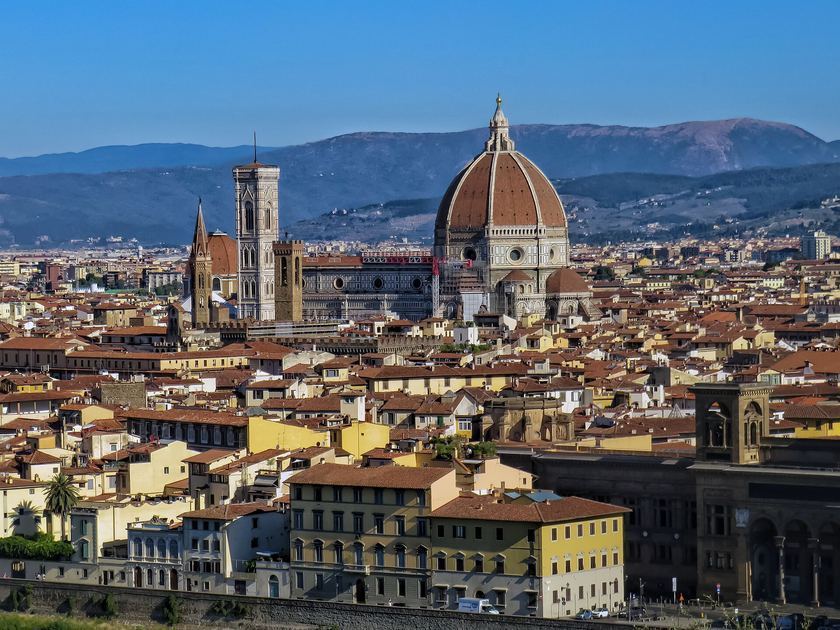
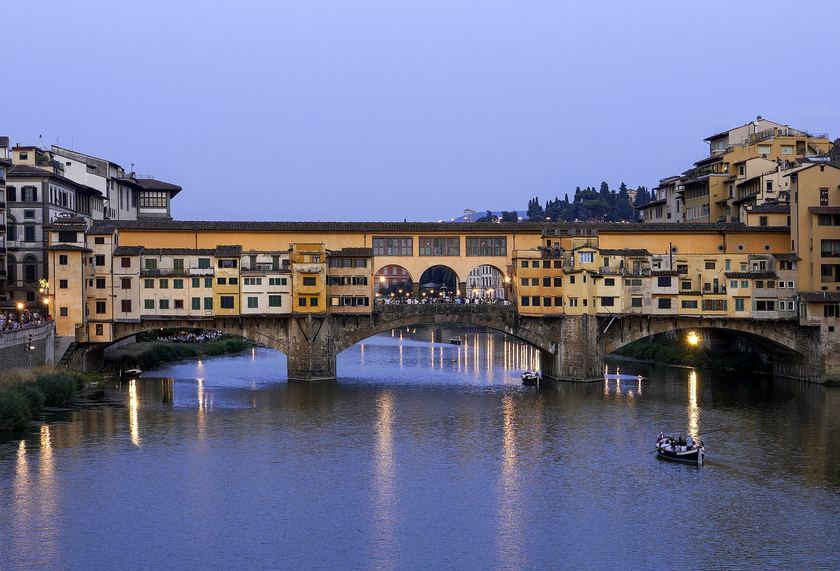
Florence is compact enough to cross on foot. Its central sights also form a workable cluster: Florence Cathedral, the Uffizi Gallery and Ponte Vecchio all sit within the historic centre. That geography does not change between March and May.
The weather changes how you use the city rather than which core sights are feasible. In March, it is sensible to alternate outdoor walks with indoor visits. April supports a more even split. In May, longer daylight gives you greater freedom to leave outdoor exploration until later in the day.
The museum core provides a rainy-day framework
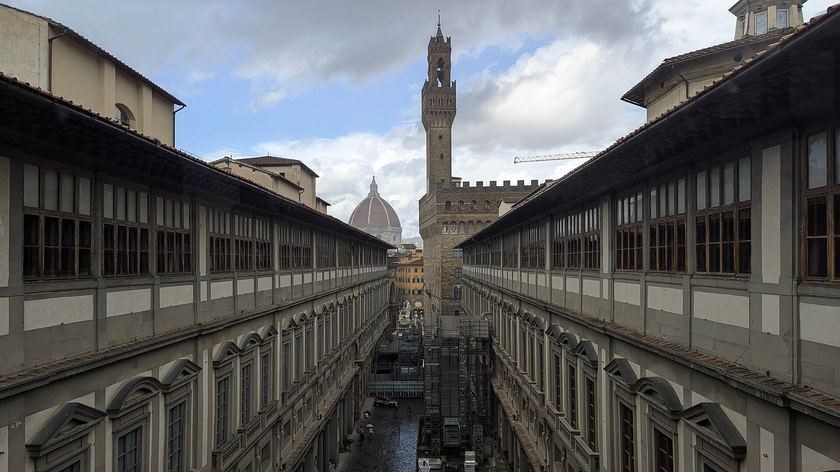
The Uffizi Gallery remains a substantial indoor anchor in any spring month. Because the Fact Pack does not provide opening hours, prices or admission rules, check availability and book through the official Uffizi website rather than relying on an assumed schedule. You can also consult our Uffizi Gallery place guide.
A useful planning principle is to avoid assigning every outdoor activity to one fixed day. Keep the museum portion of your itinerary adjustable until a current forecast becomes available.
A first visit still needs realistic pacing
Spring's longer days do not remove admission queues or the concentration required for a major museum. Avoid treating extra daylight as a reason to overload the itinerary. A three-day first-time itinerary gives you more flexibility to move indoor and outdoor plans around than a tightly packed single day.
Shoulder spring or peak spring?
The Fact Pack does not contain visitor numbers, accommodation prices or crowd data, so it cannot support claims that one spring month is quieter, cheaper or busier than another.
For a climate-based decision:
- Prefer March's early-spring conditions for cool walking weather, lower typical rainfall totals and a museum-led itinerary.
- Prefer April when you want the strongest compromise between warmth, daylight and rain frequency.
- Prefer May's late-spring conditions when warm days and long evenings outweigh its higher typical rainfall.
If “shoulder season” means lower prices or fewer visitors to you, compare current accommodation rates and ticket availability for your exact dates rather than choosing solely from climate averages.
How to plan for spring rain
Spring is not consistently dry in Florence: all three months record at least 10.5 median rain days. The most resilient itinerary combines the compact central walking route with one or more indoor anchors.
A practical approach is to:
- Reserve admission-dependent museums through their official sites.
- Keep central outdoor landmarks on flexible parts of the itinerary.
- Check the short-range forecast before assigning a day to viewpoints or extended walks.
- Pack for the monthly temperature range, not just the median high.
March needs the warmest evening layer. April still calls for adaptable clothing. May permits lighter clothing more often, but a rain layer remains relevant because it has the highest spring rainfall figures.
Final verdict
For most travellers, April is the best month for Florence in spring. It is appreciably warmer and lighter than March while recording fewer typical rain days and less total rainfall than May.
Choose March for cooler walking and an indoor-outdoor itinerary. Choose May for warmth and long evenings, accepting that it is statistically the rainiest of the three. None is a guaranteed dry-weather choice.
Frequently asked
What is the best spring month to visit Florence?
April offers the best overall balance. Its median daytime high is 19.2°C, it has 13 hours 25 minutes of daylight around mid-month, and its median 10.5 rain days are fewer than May's 13.5.
Is Florence cold in March?
March has a median daytime high of 15.6°C and a median night low of 5.4°C. Cooler daytime highs in the dataset reach 11°C, so layers are advisable, especially after sunset.
Which spring month is rainiest in Florence?
May is the rainiest of the three spring months in the climate record, with a median 13.5 rain days and 101.6 mm of monthly rainfall. March and April each record 10.5 median rain days.
Which spring month has the most daylight in Florence?
May has the longest days. Around 15 May, Florence receives approximately 14 hours 43 minutes of daylight, compared with 13 hours 25 minutes in April and 11 hours 52 minutes in March.
Is Florence walkable in spring?
Florence is compact enough to cross on foot in every spring month. April has the most balanced walking conditions, while March is cooler and May is warmer but has more typical rain days.