Best Time to Visit Florence: Month-by-Month Comparison
Compare Florence month by month for temperatures, rain and daylight, with clear picks for first visits, summer heat, autumn and Christmas.
The short answer
April is the best time to visit Florence for the broadest range of travellers. Its typical median daytime high is 19.2°C, nights average 8.1°C, and mid-month has about 13 hours 25 minutes of daylight. Rain remains a consideration, but April avoids the persistent summer heat and the short days of winter.
Choose a different month if your priorities are clearer:
- March: best for heat-averse sightseeing, provided you bring layers.
- May: best for warmer evenings and long days, but it has a relatively high median of 13.5 rain days.
- June: best for long daylight and lower rainfall, if you can tolerate increasing heat.
- July or August: best only if hot, dry conditions matter more than walking comfort.
- September: best for warmth without July or August’s typical heat, though rainfall rises sharply.
- October: best for mild autumn temperatures, with a meaningful risk of rain.
- December: best when travelling during the Christmas season is the purpose of the trip, rather than for favourable weather.
This comparison uses climate medians from 2016–2025, not a forecast for your travel dates. It cannot determine which month will have the lowest hotel prices or fewest visitors because verified price and crowd data are not available.
Florence weather by month
The table compares median daytime highs, night-time lows, monthly rainfall and rain days. Daylight is the calculated length on a representative mid-month date in 2026.
| Month | Typical high / low | Median rain | Mid-month daylight | Best for | Avoid if |
|---|---|---|---|---|---|
| January | 10.8°C / 2.2°C | 77.9 mm / 11 days | 9h 16m | Cold-weather city breaks | You want long days or mild evenings |
| February | 13.2°C / 3.7°C | 94.2 mm / 11 days | 10h 30m | A cool museum-focused visit | You dislike damp, changeable winter conditions |
| March | 15.6°C / 5.4°C | 72.5 mm / 10.5 days | 11h 52m | Heat-averse walkers | You want reliably warm evenings |
| April | 19.2°C / 8.1°C | 80.7 mm / 10.5 days | 13h 25m | A balanced first visit | Rain would seriously disrupt your plans |
| May | 22.6°C / 11.9°C | 101.6 mm / 13.5 days | 14h 43m | Warm days and late daylight | You are prioritising low rain risk |
| June | 29.1°C / 16.5°C | 42 mm / 7.5 days | 15h 26m | Long days and relatively low rainfall | You struggle with heat |
| July | 32.1°C / 19.2°C | 19.1 mm / 6 days | 15h 09m | Hot, predominantly dry conditions | You plan extensive daytime walking |
| August | 32.5°C / 19.3°C | 40.8 mm / 6 days | 14h 01m | Travellers comfortable in high heat | You need cool afternoons or nights |
| September | 26.4°C / 16°C | 110.9 mm / 9.5 days | 12h 33m | Warmth with less extreme heat | You expect summer-level dryness |
| October | 21.4°C / 11.9°C | 106.9 mm / 12 days | 11h 04m | Mild autumn sightseeing | Rain is a deal-breaker |
| November | 15.5°C / 7.4°C | 150.7 mm / 13.5 days | 9h 41m | An indoor-led itinerary | You want dry days and evening daylight |
| December | 12°C / 3.5°C | 90.8 mm / 12.5 days | 8h 57m | A Christmas-season trip | You want long outdoor sightseeing days |
Rain-day figures do not indicate how long rain lasts on each affected day. Use them to compare months, not to assume that every recorded rain day will be a complete washout.
Spring: the most balanced choice for a first visit
March: cool, comparatively moderate rainfall
March has a typical high of 15.6°C and no days over 30°C in the climate sample. Its 72.5 mm median rainfall is lower than April’s and May’s, but nights remain cool at a median 5.4°C.
Choose March if avoiding heat is more important than having warm evenings. It is less suitable if you want to spend late evenings outside without extra layers. See the Florence in March guide for month-specific planning.
April: the best overall compromise
April combines a 19.2°C median high with considerably more daylight than March. Temperatures can still vary: the 10th-to-90th percentile range for daytime highs is 14.6–23.3°C. That makes adaptable clothing more useful than planning around a single average.
For a first visit built around walking across Florence’s compact centre, April is the strongest climate-based choice. Read Florence in April alongside the first-time Florence guide.
May: warmer and brighter, but not drier
May offers a median high of 22.6°C and almost 14 hours 45 minutes of mid-month daylight. The trade-off is rain: its median 101.6 mm and 13.5 rain days are both higher than April’s figures.
May suits travellers who value warmer evenings and long sightseeing days but can keep plans flexible. It should not be chosen on the assumption that late spring is Florence’s driest period. The Florence in May guide covers the month in more detail.
Summer: long days versus significant heat
June: the best summer compromise
June has the longest mid-month daylight of the year at about 15 hours 26 minutes, while median monthly rainfall drops to 42 mm. However, it is already hot: the median high is 29.1°C, with an average 12.3 days over 30°C in the climate sample.
Choose June over July or August if you want a summer trip but are concerned about extreme heat. Travellers who are particularly heat-sensitive may still be better served by April, May or October. See Florence in June.
July and August: driest conditions, hardest for daytime walking
July records the year’s lowest median rainfall at 19.1 mm. Both July and August have six median rain days, but their typical daytime highs exceed 32°C. The climate sample averages 23.4 days over 30°C in July and 22.9 in August. Median apparent afternoon temperatures are 33.6°C and 32.9°C respectively.
These months work best for travellers who actively prefer heat and can avoid loading the afternoon with continuous outdoor sightseeing. Florence’s long daylight gives you room to shift some walking away from the hottest part of the day, but evenings also remain warm.
Compare Florence in July with Florence in August before choosing. Do not assume anything about August closures or attraction schedules: check each official site for your dates.
Autumn: milder temperatures, rising rain risk
September: warm rather than cool
September’s median high is still 26.4°C, and the sample averages 6.5 days over 30°C. It is therefore a better transition month for travellers who want warmth than for those seeking distinctly cool weather.
Rain rises to a median 110.9 mm, compared with 40.8 mm in August. September is a useful alternative to peak summer heat, but not a reliably dry substitute. Read Florence in September.
October: comfortable temperatures with a wet-weather trade-off
October’s median high of 21.4°C is well suited to walking, and nights average 11.9°C. Its disadvantages are shorter days and a median 106.9 mm of rain across 12 rain days.
For heat-averse travellers, October competes closely with April. Pick April for substantially longer daylight; pick October if its autumn timing better fits your trip, while accepting similar rain-related uncertainty. See Florence in October.
November: the wettest month in the data
November has the highest median monthly rainfall at 150.7 mm, together with 13.5 rain days. Mid-month daylight falls below ten hours, and the median high is 15.5°C.
It is a poor climate-based choice for travellers whose priority is long outdoor days. If November is fixed, build an itinerary that can move between outdoor walks and major indoor visits. For the Uffizi Gallery, check current admission arrangements directly on its official site before travelling.
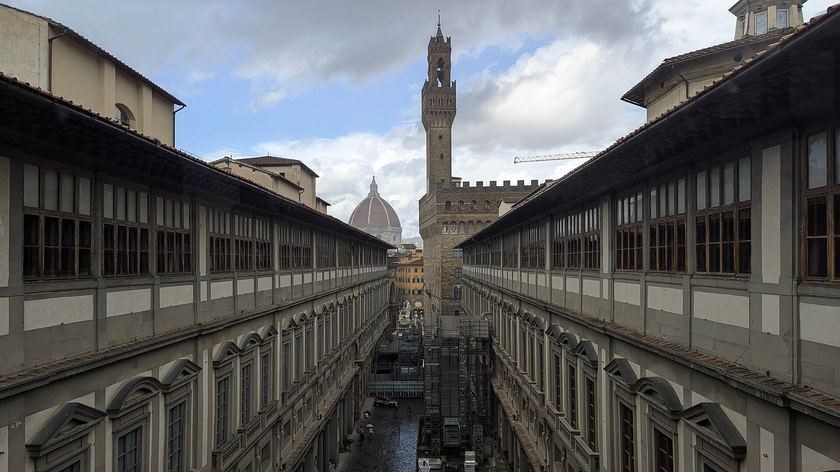
Use the Florence in November guide and the Uffizi Gallery place page when planning.
Winter: cool weather and limited daylight
December: choose it for the Christmas calendar, not the climate
December has the shortest mid-month day of the year at about 8 hours 57 minutes. Its typical high is 12°C, while nights average 3.5°C. Median rainfall is 90.8 mm across 12.5 days.
December is the logical month if being in Florence during the Christmas season is central to the trip. The available evidence does not include a verified festival, market or holiday-opening calendar, so confirm seasonal events and attraction schedules separately. Start with Florence in December.
January: the coldest typical days and nights
January has the lowest median daytime high at 10.8°C and the lowest median night-time temperature at 2.2°C. Its 77.9 mm median rainfall is lower than February’s or December’s, but daylight remains limited.
It suits travellers who are comfortable structuring shorter outdoor periods around indoor visits. See Florence in January.
February: slightly milder, with growing daylight
February’s median high rises to 13.2°C, and mid-month daylight reaches 10 hours 30 minutes. Rainfall is higher than in January at a median 94.2 mm, with the same median number of rain days.
Choose February over January if the extra daylight and slightly milder afternoons matter more than the rainfall difference. Read Florence in February.
How to choose based on your priorities
| Your priority | Best shortlist | Main trade-off |
|---|---|---|
| First visit | April, May or October | May and October have relatively high rainfall |
| Avoiding heat | March, April or October | March is cooler; October has shorter days and more rain |
| Long daylight | May or June | May is wetter; June is much hotter |
| Lowest typical rainfall | July | Median highs exceed 32°C |
| Warm but less extreme than midsummer | September | Rainfall rises substantially from August |
| Christmas-season travel | December | Cold weather and the shortest daylight |
| Indoor-led trip | November to February | Short days and cool or wet conditions |
What climate data cannot tell you about crowds and cost
It is tempting to label spring and autumn as “shoulder season” and winter as the cheapest period, but this Fact Pack contains no verified hotel, flight, ticket-demand or visitor-volume data. Local conditions can also vary by exact date.
Budget travellers should compare live accommodation and transport prices across their feasible dates rather than assuming a month will be cheaper. Crowd-sensitive visitors should check ticket availability for priority attractions before committing. No booking requirement is verified here, so use official attraction sites for current arrangements.
Once you have selected a month, the next decision is trip length. Compare two days in Florence, a three-day first-timer’s itinerary and the guide to how many days you need in Florence.
Frequently asked
What is the best month to visit Florence?
April is the best overall climate-based choice for most first-time visitors. Its median high is 19.2°C, with about 13 hours 25 minutes of mid-month daylight. Rain is still possible, so it is a balance rather than a guarantee of dry weather.
What is the driest month in Florence?
July has the lowest median monthly rainfall at 19.1 mm and a median of six rain days. The trade-off is heat: its typical high is 32.1°C, with an average 23.4 days over 30°C in the climate sample.
When is Florence hottest?
July and August are typically the hottest months. Their median daytime highs are 32.1°C and 32.5°C respectively, and each averages more than 22 days over 30°C.
What is the rainiest month in Florence?
November has the highest median monthly rainfall at 150.7 mm and a median of 13.5 rain days. May also records 13.5 median rain days, but a lower monthly rainfall total of 101.6 mm.
Is December a good time to visit Florence for Christmas?
December is the appropriate choice if Christmas-season timing is the main reason for travelling. Typical conditions are cool, with a 12°C median high and about 8 hours 57 minutes of mid-month daylight. Confirm events and holiday opening arrangements separately because they are not covered by the available data.
Which month is best for avoiding heat in Florence?
March, April and October are the strongest options for heat-averse travellers. March is coolest, April has considerably longer daylight, and October is mild but has higher rainfall and shorter days.