Getting Around Florence: Walking, Tram, Bus and Taxi
Compare walking, tram, bus and taxi in Florence, with practical advice for central and farther-out stays, luggage, stations and the ZTL.
The short answer
For most sightseeing in Florence’s historic centre, walking is the best default. The city is compact enough to cross on foot, and major central sights including Florence Cathedral, Mercato Centrale, the Uffizi Gallery and Ponte Vecchio form a relatively concentrated sightseeing area.
Trams and buses become more useful when your accommodation is outside the centre or when repeated walks would be tiring. A taxi is most worthwhile for luggage, reduced mobility or a journey where simplicity matters more than cost. If you are bringing a car, check Florence’s ZTL and access arrangements before driving towards the centre.
Which mode suits your stay?
| Trip or stay type | Best starting choice | Main trade-off |
|---|---|---|
| Staying in the historic centre | Walk | Simple for central sights, but a full day can still involve substantial time on your feet |
| Staying farther from the centre | Tram or bus | Can reduce repeated walks, but usefulness depends on the route from your accommodation |
| Travelling with luggage | Taxi or relevant public transport connection | Taxi is simpler; public transport may require more handling and changes |
| Limited mobility or low walking tolerance | Taxi, with selective walking | Reduces overall walking, though you should confirm suitable drop-off and access arrangements |
| Visiting mainly central landmarks | Walk | Public transport may add waiting and route-finding without saving much effort |
| Bringing a car | Leave it outside restricted central access where appropriate | Driving towards the centre requires advance ZTL planning |
When walking is enough
Walking is usually enough when you are staying in or close to the historic centre and concentrating on its main sights. Florence Cathedral, Mercato Centrale, the Uffizi Gallery and Ponte Vecchio are all within the central part of the city, so using public transport between each stop is unlikely to simplify the day.
A sensible central sightseeing sequence is to group places rather than return repeatedly to your accommodation. For example, combine Florence Cathedral and Mercato Centrale in one part of the day, then continue through the centre towards the Uffizi Gallery and Ponte Vecchio. This is a planning suggestion rather than a fixed itinerary; museum bookings and your walking tolerance should determine the final order.
Walking may be a poor default if:
- your accommodation is beyond the central sightseeing area;
- you expect to return to your room several times during the day;
- luggage makes the arrival or departure walk awkward;
- someone in your group cannot comfortably manage a day largely on foot;
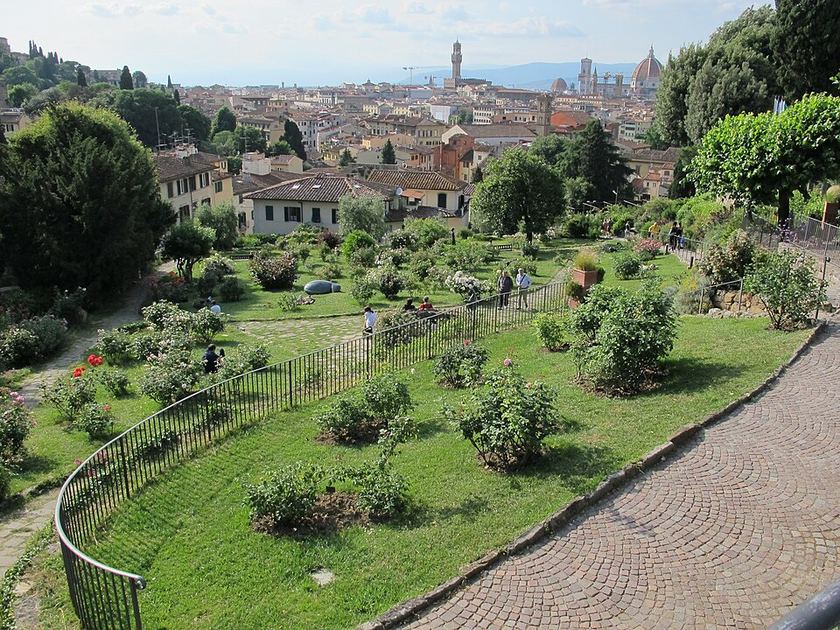
- you are visiting Piazzale Michelangelo as well as several central sights and want to reduce the total effort.
Piazzale Michelangelo is less tightly grouped with the central attractions in this guide. It is therefore the clearest example of a place where checking a bus or taking a taxi may be preferable to automatically walking both ways.
When to use Florence’s tram
Consider the tram when your accommodation has a convenient connection but is not within an easy walk of the historic centre. It can make particular sense for a stay based farther out, where the same journey into and out of central Florence would otherwise be repeated every day.
Do not choose accommodation simply because a tram is mentioned nearby. Before booking, check the current route against the part of the centre you expect to use most. A connection is only useful if it reduces your actual door-to-destination journey rather than leaving a long walk or an inconvenient change.
Schedules, frequencies and fares are not available in the supplied information, so confirm them with the official transport operator for your travel dates.
When the bus is more useful
A bus is worth considering when it serves your accommodation or a less central destination more directly than the tram. It can also help limit walking on a day that combines the historic centre with Piazzale Michelangelo.
For a visitor spending almost all day around the Duomo, Uffizi and Ponte Vecchio, however, buses are unlikely to replace walking between individual sights. Use them to bridge a meaningful gap, not for every short movement through the centre.
Check current routes, stops and ticket rules before travelling. No verified fare, timetable or service-frequency information is available here.
When a taxi is worth it
A taxi is primarily a convenience choice rather than the default way to sightsee in central Florence. It is most useful when:
- you have luggage;
- walking is difficult for someone in your party;
- your accommodation is poorly placed for a direct public transport journey;
- you want to simplify a single transfer;
- you would prefer to reduce the effort of reaching or returning from Piazzale Michelangelo.
For a day spent moving among central landmarks, taxis may offer poor value compared with walking. They also do not remove the need to plan around access restrictions in the historic centre. Confirm current booking arrangements, fares and suitable pick-up or drop-off points locally rather than relying on an assumed flat rate.
Arriving at Santa Maria Novella station
Your best onward option from Firenze Santa Maria Novella depends on where you are staying and how much luggage you have. If the accommodation is in the central sightseeing area, walking may be sufficient; for a farther stay or heavy luggage, compare the relevant public transport connection with a taxi.
Use the dedicated Florence Santa Maria Novella station guide for station-specific arrival planning. Exact station exits, local routes and transfer details are not included in the available information for this article.
Getting from Florence Airport
Airport transfers require different planning from everyday movement around the city. Use the dedicated Florence airport transfer guide to compare the available arrival options for your accommodation and flight time. Airport fares, schedules and transfer times are intentionally not covered here.
Driving and Florence’s ZTL
A car is not the practical default for moving among Florence’s central sights. If your wider Tuscany trip requires one, check the ZTL and your accommodation’s access and parking arrangements before approaching the historic centre.
Do not rely on general driving advice or assume that a central hotel can always be reached without restrictions. The dedicated Florence driving and parking guide should be used for current ZTL rules, permitted access and parking planning.
A simple decision rule
Choose your transport in this order:
- Start with walking if you are staying in the historic centre and focusing on central sights.
- Check tram or bus routes if your accommodation is farther out or you want to reduce a repeated journey.
- Use a taxi selectively for luggage, mobility needs or a transfer that is inconvenient by public transport.
- Treat airport and station arrivals separately from daily sightseeing.
- Plan for the ZTL before driving, rather than dealing with access restrictions after reaching the centre.
Frequently asked
Can I get around Florence without using public transport?
Usually, yes. Florence is compact enough to cross on foot, and Florence Cathedral, Mercato Centrale, the Uffizi Gallery and Ponte Vecchio are concentrated in the central sightseeing area.
When is public transport worth using in Florence?
Public transport is most useful when your accommodation is outside the historic centre, when you would otherwise repeat a longer walk each day, or when you want to reduce the effort of reaching a less central destination such as Piazzale Michelangelo.
When should I take a taxi in Florence?
A taxi can be worthwhile when travelling with luggage, when someone has limited walking tolerance, or when the public transport journey from your accommodation is inconvenient. It is generally unnecessary for moving between closely grouped central sights.
Should I drive in central Florence?
A car is not the practical default for central sightseeing. Florence has a ZTL, so check current access rules, parking arrangements and any instructions from your accommodation before driving towards the historic centre.
Should I walk from Santa Maria Novella station to my hotel?
It depends on your accommodation and luggage. Walking may suit a central stay, while public transport or a taxi may be better for accommodation farther away. Consult the dedicated Santa Maria Novella station guide for station-specific details.